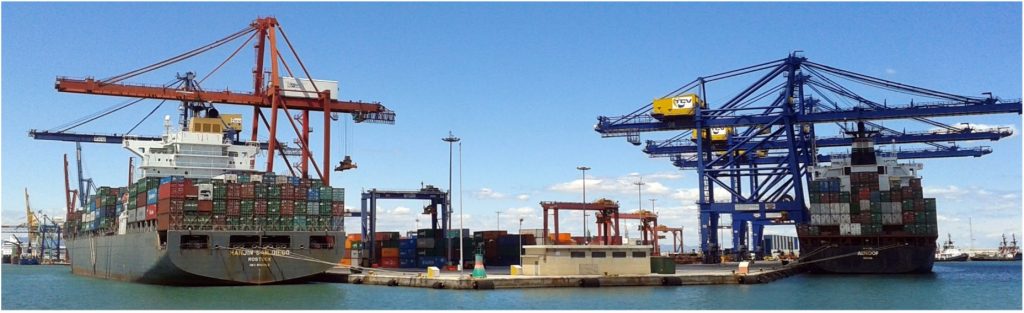
As it is known, a port’s competitiveness does not depend solely on its own growth, but rather on the overall performance of all cluster stakeholders, and this is where an “active” innovation policy is key. This role was perfectly assumed by the Fundación Valenciaport, created in 2004 by the Port Authority of Valencia, in collaboration with various other associations, companies and institutions, as a research and training centre acting as implementation tool for the innovation policy in the cluster.
Since then, more than 450 companies have worked during these fourteen years with the Fundación Valenciaport’s team on the different areas of expertise demanded by the market. The Fundación was conceived with a clear service-oriented intention to a cluster that has consolidated over time, leading projects that have positioned companies from the Valencian port logistics sector and the whole cluster on the front line.
Over these years, Fundación Valenciaport has been actively involved in or has managed more than 200 European initiatives, in addition to providing technical assistance on 15 occasions to Latin American countries, as well as several initiatives carried out for the Port Authority of Valencia (PAV).More than 60% of all the projects undertaken by Fundación Valenciaport could be classified as pure innovation (focusing on the development of prototypes or pilot testing) and deployment, rather than the standard research studies. This high percentage attests to the commitment of Fundación Valenciaport to be at the service of the cluster, in addition to its clear intent to continue to be the instrument to implement improvements and innovation to both the infrastructures and the technologies used in its areas of business.
 Fundación Valenciaport operates in a broad spectrum of areas:
- Logistics and intermodality.
- Information technologies.
- Security and protection.
- Port planning.
Similarly, the collaborating companies come from across the entire transport chain, from exporters, to road transport operators, railway services operators, freight forwarders and logistics operators, shipping agencies, diverse types of terminals, technical-nautical services, customs, other governmental organisations and international institutions.
With regard to training, it highlights the excellent performance of the Master’s in Port Management and Intermodal Transport, which is now well into its 27thedition and which, year after year, consolidates its position as the number one Spanish-speaking training programme in Trade, Transport, Logistics and Ports, with a growing international prestige, receiving very positive feedback from professionals and young post-graduates not only in Spain but also in the rest of Europe and in Latin America.
In particular, the logistics and intermodality programme expands the field of expertise of the Fundación Valenciaport far beyond the purely port-related ones, providing it with a comprehensive vision of the logistics infrastructures and chain. The comprehensive design of the logistics system is necessary to be able to deal with the present and future situation in a globalized world where logistics has become an essential part of competitiveness and where ports set themselves up as key elements of the logistics chain. Container logistics, the connection of ports with their hinterland, maritime and rail integration, logistics nodes and intermodal logistics platforms, the integration and competitiveness of the port logistics cluster or urban logistics are just some of the fields where we have continued to work from a strategic perspective and of planning from an operational optimization perspective and improvements to efficiency.
Looking ahead, Fundación Valenciaport has set several challenges for the coming years, including strengthening the areas where it already enjoys a prominent position, such as energy efficiency, with the incorporation of hydrogen fuel cells; the services associated with new fuels; the implementation of technologies linked to concepts such as the Internet of Things, wearables or big data, to improve port services and procedures; fostering cruise ship business and encouraging new facilities to improve railway interconnection; as well as sustaining the levels achieved in international cooperation in Latin America.
Fundación Valenciaport has been working with members of the Open ENLoCC network for many years. It decided in December 2017 to join Open ENLoCC Network as its experience and its challenges fits perfectly with the objective of Open ENLoCC) in order to exchange the experience and knowledge in logistic and promote the cooperation with other European institutions.