
Obstacles to be addressed and the current situation
The relevant obstacles in the implementation of RCL have been outlined in the survey carried out in the previous study by Open ENLoCC.
The picture that emerges from these outcomes allows to underline the difficulty of sharing and coordinating in a mainly competitive environment, which presumably could be contrasted through raising awareness about possible benefits.
Then, these first barriers are overcome, other factors that must be considered include knowledge gaps and other aspects that imply a key role of the public sector (both acting as a facilitator and in addressing legal issues).
More generally, these outcomes testifying relevant obstacles are also related to the need for a behavioural change to be overcome find correspondences in the literature.
Obviously, these obstacles must be assessed bearing in mind the current level of collaboration in the SCs, especially at the regional level. Then, in order to appropriately assess the current state of play, the participants in the questionnaire were asked, with particular reference to horizontal collaboration (esp. between SMEs), to rate the current level of sharing (0 = no sharing, … 4= complete).
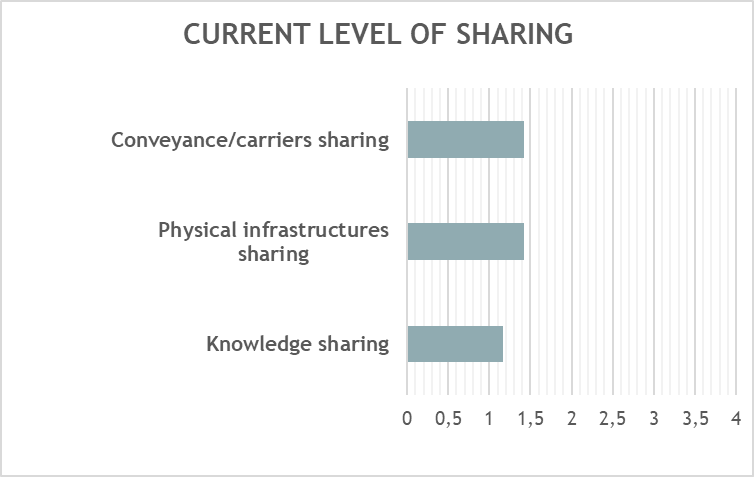
The obtained outcome highlights a low level of sharing even in the more operational side of conveyance/carriers sharing. It is quite understandable that, in such conditions, the knowledge sharing level is marking an even lower value.
More in general, implementing collaborative logistics demands consensus on organisational setup and operational schemes—ideally progressing beyond the sharing of single transport modes (e.g., trucks) toward more integrated and multimodal solutions. Hence, currently, the majority of collaboration projects remain limited to tactical or operational levels, such as truck sharing and less-than-truckload (LTL) consolidation; more advanced strategic integration remains rare.